Thursday, July 17, 2008

New World Food Order

Guy: So Zola's previous post "Vision Quest..." inspired me to try a dish I happened upon in Mexico City when I was there on a rock mission a couple of years back. It was actually the masa cake gorditas that inspired me. 2 winters ago, Mudhoney were lucky enough to open up for Pearl Jam on a number of South and Central American dates, the final one being at the Armadillo dome in Mexico City. PJ were very accommodating and kind to us, and in fact allowed us to tape this show on their recording system. It later became Mudhoney's Live Mud live in Mexico city album.

Whilst on this trip, Mark, my friend Jim and I took a trip to the Presidential palace on our day off. The palace is located next to an Aztec ruin and a magnificent basilica. The palace itself contains the epic fresco mural by Diego Rivera that depicts the history of the Mexican nation. The whole central plaza is awash with street vendors of all kinds. Of course my favorites were the food vendors. Undeterred by Mark and Jim's fearful warnings about the street food, I ploughed into some blue corn gorditas topped with Nopales and Queso Fresca. Nopales is cactus, a local staple in the Mexico city area. The dish is often referred to as nopalitos, the diminutive for cactus. Zola's gorditas reminded me of this dish, so I was off to our local Carniceria for some Nopales and Chicharron. Our local carniceria is located where Boren hits Rainier Ave. It's an unassuming little front that opens on to a large and well stocked Mexican market. The friendly and helpful manager provided a few tips as he whipped out 5 large fresh nopales leaves from his walk -in. 
So, here's how it's done. The gorditas are essentially Zola's previous recipe with a little extra salt and a couple of large pinches of sugar, no further explanation needed. 
The black beans were made with 1 can of black beans, 1 small can of Salsa Verde Picante and some onion powder. Stew this in a pot until hot and add 6 to 8 one inch pieces of chicharron seco (porn rinds)(Zola: I think it's safe to assume Guy intended to write pork rinds but I'm enjoying the typo too much to correct it). Stew until the texture of the pork rinds are soft. 
Now for the Nopales. Mine were bought de-spiked but if yours are not, get those spikes off or your in for an 'Arrowing meal! The raw nopales are very easy to slice with a sharp knife, I did mine in 1/4 inch strips as I remembered from Mexico city. Next stew them at a low boil with some garlic and salt in a shallow pot of water, for about 15 to 20 minutes. You can check them from time to time, their texture when ready should be that of a firm perfectly cooked green bean.  Next drain the Nopalitos, chop some more fresh garlic and add to a pan with some olive oil on a medium high heat. saute the cactus for a short time till it is well coated in olive oil.
The next stage is the plating, I topped our rather substantial gorditas half and half with bean and nopales. Then added some queso fresca on top. best method is to gouge and scape the cheese of the block with a fork. The plate is then garnished with tomatoes and avocados. 
There  you have new foods from the new world! Don't forget to locate your local carniceria for your authentic ingredients, Bon Provecho.  

Tuesday, July 15, 2008

Vision Quest v. Dream Haters

Zola: Every once in a while my brain actually cooperates with me. And every once in a very great while, it actually does something nice for me--like give me an awesome, completely escapist fantasy dream. Last week, said brain delivered the goods. Now I know that there are a lot of people in the world who really hate it when people launch into their dreams. Fair enough. But I think all you dream-haters out there will even appreciate this one. Plus it was (mercifully for you, sadly for me) short. Here's what the old brain kicked out: I'm sitting in a cafe, drinking coffee with Anthony Bourdain, AKA: my new boss. See? So great already, right? We're in this cool old late '50's cafe--very Canter's-eque--and he starts to explain what my job is. It's something to do with project managing things on location/researching restaurants, food histories, etc. Anthony is like, "so... I'm really excited to have you join our team." And of course--because it's a dream--I'm super casual and say, "yeah, let's talk a little more about what exactly you're imagining will be involved." but the subtext is obviously: "yeah dude, of course you are. I'm about to manage the shit out of these programs." Now let's be absolutely clear about this: I am never cool like this; not even in my dreams. This dream is very quickly moving further up on the greatest-dream-ever-o-meter.  So my new boss, Anthony, says, "Let's go get some food and we can talk more about it." We hit the road and just begin to start talking more about what he needs me to do when he abruptly pulls the car over as he says, "this place has an amazing dish." We walk in and, because I'm with Bourdain, the dish is served to us immediately. It is a small, deep gordita/masa patty with a poached egg and two slices of perfectly cooked steak on the top. A vision.

When I went to cook this, I realized the hardest part of this dish would be the timing. Nothing in it takes very long to do, and everything is actually rather time sensitive. I decided to add some collard greens with bacon because a) it seemed like the dish needed something green, b) it seemed to suit the flavor of the dish and c) our neighbor just gave us a ton of bacon for watching her cat (maybe she's seen the bacon bumper stickers? cats like bacon? I'm not sure I get the connection but I'm not complaining). So here's what I did and in the order I did it, to make this dream a reality.

Start by cleaning the greens. Or in my case, get Guy to clean and cut the kale before you get home from work. I chopped some bacon and peeled some garlic, and set that on a low heat to start cooking. While that was going, I started on my masa dough.
Here's the recipe I followed for gorditas:
1 3/4 c. masa flour
1/4 c. flour
pinch salt
1 tsp. baking powder
1 c. + 2T water
2T vegetable shortening
They say to mix masa and water and add other ingredients. Next time I make gorditas, I'll mix my dry ingredients, LARD (what was I thinking? vegetable shortening. puh-lease.) and then the water. I would also add more salt than a pinch, maybe some sugar and definitely some pepper.
Knead, knead knead. Shape into little happy gordita shapes (ovals about 1/4" thick) and start cooking one up on a griddle. FYI the first time you do this recipe, be sure to make a little test buddy so you see how it cooks, if it's falling apart, etc.

As soon as you've got your gorditas going, put your frying pan on with butter for your steak; put your greens in your bacon & garlic on a medium heat with a little water and cover; and get a pot of water with 2 T of white vinegar coming up to a boil.

Get your steak pan hot and start frying that puppy up. Once it's cooked with a nice dark sear and pink inside, wrap it up in foil, pour extra butter/meat drippings on it and let it rest.

Don't forget to flip your gorditas! And check your greens. Don't let them get brown. Add a little vinegar to greens for some brightness because you've got a motherload of rich, salty goodness coming your way.

Once your gorditas are done, take the lid off your boiling water and let the water come back down to a simmer. Carefully drop your eggs in the water. Slice your steak. Plate gordita, pull out egg, and place sliced steak. Toss and plate greens.

Voila! I would serve this again, but maybe for a hangover breakfast. Which would explain why my new boss Anthony liked it so much.

Sunday, July 6, 2008

Half a Sheep

Zola: Hard to believe, but yesterday was our 10 year wedding anniversary so I needed a very special celebratory meal. I'd been saving Laurent's tale of marriage and meat for just such an occasion.

Laurent: Patricia was busy working on a weekend, while I was relaxing at home by myself enjoying a few beers on a lazy and hot summer afternoon. Suddenly, the doorbell rang.

My father in law announced himself,

"Laurent... are you home? It's Ricardo, your father-in-law..."

I should mention that I was recently married and had only been living in Brazil less than half a year. My Portuguese was still a bit rough.

"Ricardo, ah... eh ... come on up" I responded and hit the intercom button opening the door.

A minute or so later their was a knock on the door. I had started to say hello, but stopped mid-sentence a bit taken back. My father-in-law was standing at the door holding a large plastic bag containing a bloody carcass.

Without missing a beat, Ricardo said, "We were in the countryside at a friend's farm and bough a sheep, I thought that you may want half of it and had it cut in two."

He extended the bag to me for me to take it. I grabbed the bag and exclaimed "Of course!" and almost dropped the bloody bag still slippery and moist. I quickly asked if he wanted a beer or a shot of rum, but he gracefully declined. Ricardo excused himself, saying that people were waiting for him in the car downstairs and he had to get going. He gave me an awkward hug and left me with a half a sheep in a bloody bag.

The carcass was still warm, fresh from the slaughter. With the sweltering summer afternoon not expected to cool off soon, I had to refrigerate the meat quickly. I tried to stuff the carcass into the refrigerator with the idea of dealing with it later it would not fit. Even after removing all the shelves the half sheep was already too stiff to curl and too large to close the door. I realized that I would have to divide the carcass into smaller parts if I hoped to refrigerate it.

I had never butchered any thing bigger than a duck or a large trout into edible parts. A little intimidated, I took off my shirt, put on an apron and started to hone a couple kitchen knives against the back of a plate. While I was sharpening the knives, I scoured my mind on how to best go about butchering the sheep. With no answers ready in mind, I open another beer and cleaned the stainless steel sink. The sink, I reasoned would be the best place to put the half-carcass, while I was working on cutting it into smaller pieces.

Carefully I took the sheep out of the bag and slid it into the sink. While doing this, I succeeded in splattering myself with the blood and liquid that had been in the bottom of the bag. My white apron was already getting dirty and I had not even begun to cut. Looking at the half sheep inside the sink, decided to first separate the legs; creating three manageable pieces instead of one large slippery section.

Slowly, but surely over the course of the next few hours I managed to detach the two legs and butterfly them. While the foreleg was easy to remove, the hind leg presented a greater challenge. Finally, with a fell swoop of the ten inch chef knife I managed to detach both the hind leg and the tip of my index finger.

The blood on my apron and arms was now a mixture of mine and the sheep's. I quickly went dripping to the bathroom in search of a band aid and first aid supplies. Rummaging through the bathroom cupboards, I did not find a single band aid or any rubbing alcohol. I found some feminine sanitary napkins and reasoned that they were designed for absorbency. Quickly, I wrapped one around my finger and held it in place with my uninjured hand. After searching some more for some tape and a disinfectant, I found a roll of black electric tape and a bottle of cachaca, strong Brazilian cane spirits. After disinfecting my finger with the cachaca and securing the menstrual pad to my finger, I took a big swig from the bottle and got back to work.

Ding dong rang the door bell. Without thinking of my appearance and still holding the knife I ran to open the door.

Patricia screamed. With the half a sheep, a couple bottles of beer and less the tip of a finger, time had passed and she had already returned from work. Standing in my shorts with only an apron on, reeking of cachaca, wielding a large kitchen knife and dripping blood with a menstrual pad wrapped around my finger, I must have been a frightening sight. After reassuring my wife that she had not married a psychopath, I explained the situation to her and finished butchering the mutton.

The only way to thank the generous gift of a half a sheep was to make a feast. I decided that we needed to invite as many people as could fit into our small fifth floor apartment so I had Patricia call up her father and invite him to dinner.

My wife's father, Ricardo, is the only Lebanese born son of a large Lebanese family, who settled in Sao Paulo in the 1950's. The family legend is rich and the Lebanese roots run deep especially in the kitchen. As a nod to their Arabic heritage I decided to use the mutton to make Moroccan Rice a recipe that I had encountered while living in Paris and managed to hobble together recipe researching online.


The recipe is as follows:

Ingredients

2 cups of nuts (pine nuts, almonds or/and walnuts)
One leg of mutton hacked to pieces and ground with fat

2 cups of Uncle Ben's or parboiled rice

1 cup of raisins and or dried fruit such as apricots or even cherries

2 teaspoons of Cinnamon
1 teaspoon of nutmeg
1 teaspoon of cumin
1 teaspoon cayenne pepper

Steps

Make stock
Use bones, onions, and assorted greens to make meat & vegetable stock
If Lazy use beef stock cubes

Make rice
Use stock to make rice normally
Include cardamon in rice if available
Include dried fruit in rice towards end

Meat (while rice is cooking)
Chop nuts
Fry nuts until golden in one cup of oil.
Drain nuts and retain oil.
Place nuts on paper towel to remove excess oil
fry spices in oil
Add ground meat and stir
Continue cooking until well separated
Salt to taste

Assembly
Take half of meat and mix with rice
make sure rice/meat combination fluffy
Serve in large dish
Top with remaining meat and with fried nuts

Serve with sides of arabic salad, cucumbers, onion, tomato, Baba Ghanoush, humus, arabic (greek) style yogurt,

Zola: I didn't buy half a sheep, but I did run down to the butcher's to get a leg of lamb (which is huge, by the way). The meal was amazing. I stuck with the lamb, rice, and salad, threw in a couple of stuffed grape leaves--but I also made my own harissa to make these olives that I get down at my favorite cafe in Seattle, Cafe Presse. Make the harissa paste then pour in the entire contents of two bottles of nicoise olives.

Harissa paste:
13 oz bag of dried chili pods
6 cloves of garlic
1/2 cup of ground coriander
1/2 cup of ground cumin
1/3 cup salt
2/3 cup olive oil

Using scissors, cut off stems, take out seeds, and cut up the chili pods and put them in a bowl of hot water to soak. Put all ingredients in a food processor and blend.

Well deserved cheater dessert of chocolate gelato, fresh raspberries, and an almond florentine finished everything off.

Monday, June 30, 2008

Love me like a reptile!

Guy: The title of this posting, borrowed by Motorhead, is influenced by the combination of rock and roll and reptiles, specifically Alligator. As you may have guessed by Zola's posting last week, I have been out for the first 3 weeks of June on an east coast and southern tour as Mudhoney were out promoting our new album "The Lucky Ones".  As it happens, we were very lucky indeed. Not only did we survive 18 shows in 18 days, hard work for the 40 plus rock and roll set, but we ate like kings. I'm not talking about the sort of toothsome offerings to be found at White Castle, or Chic Fil A (I kid you not, our Garmin could find the nearest Chic at will, and I loved it for that), but we had a couple of sensational restaurant experiences that provide the background for the dish appearing this week. 


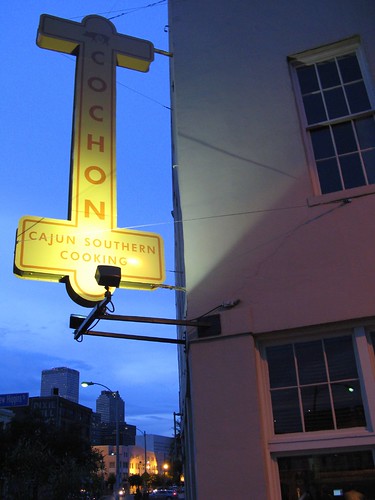
About day 6 of our tour we rolled into Columbus OH. I will not regale you with the tale of the tiny, moldy, not entirely open, un-usable bathroomed club we played, but will point you in the direction of Alanas Cafe.  It is well worth your while to seek out Alana's excellent restaurant next time your in Columbus. So as it turns out Alana's husband and sommelier Kevin is a huge Mudhoney fan, and the two were kind enough to invite us for an excellent tasting menu before our gig. Alana's menu features local produce incorporated into an inventive French/Asian fusion style. Standouts from the dinner were the vietnamese lettuce wraps, the goat casserole and the skate wing all blew my mind. All other dishes and the wine were outstanding. The inspiration for todays dish was a conversation we had with Alana after dinner. She had worked for many years in New Orleans in Emeril's original restaurant. I was fascinated by the idea of eating 'gator, and after my chat with Alana I knew this was my goal down south. My first attempt in Pensacola, FL was not very successful. A deep fried egg roll with a butt load of smokey bacon that made the Alligator in the roll undetectable. So it was on to Noor-lenz for another stunning meal at the restaurant par excellence Cochon.  I ordered mainly for the apps menu here, but my band brothers were kind enough to let me try all of their entrees. Stand outs were the Whole deep friend soft shell crab and the house speciality the Cochon pork shoulder. One of my apps became the side dish tonight. The original was a Crawfish and green tomato casserole baked in a ramekin, my version  was with prawn flesh and yellow vine tomato. But it was at Cochon that I finally got to have my real gator experience. Deep fried nuggets, a'la calamari fritos. It does not taste like chicken but was white meat. It's its own thing, one must try it to know it, suffice to say all at the table enjoyed it.

So to the Alligator de jour. As it is hard to get Alligator in Seattle, I brought back 2 cans of Dales wild west Alligator cajun style. Available in any tourist trap in the French quarter. I asked around and apparently locals will serve this stuff over rice with red beans on the side. 
So there is not much to this recipe. Boil rice add tumeric or saffron to make it yellow. Heat the tinned 'gator and poor over rice. 
My red beans were done in chicken stock, with chopped celery and onions. Spices are the classic cajun spice combo of Cayenne, black and white pepper and thyme. Slow cocked for a couple of hours. 

Wednesday, June 18, 2008

Vanilla Slice

Zola: I know, I know. I've been a complete slacker lately, but trust me--this one is worth the wait. Okay, so Guy has been on the road for the last few weeks and I wanted to make something really special for him when he got home. I usually try to make a nice, simple home cooked meal after he's been on tour, because I know there's been a lot crappy fast food, as well as some really good but rich dining experiences (for example, he finally got to go to Cochon in New Orleans--that place is amazing). I had my roast chicken, stuffed with lemons, garlic and thyme, some salad, a nice baguette; but I wanted something that said, "Welcome Home!!" Which made me start thinking, "what says welcome home to an expat?" Well, nothing says comfort like a dessert and I needed something very Australian. Enter Bryony. Bryony is a very dear, old friend of Guy's from Perth. I've only had the pleasure of meeting her once (ironically, in Perth, although she's been living in Philly for quite some time). Bryony and her posse showed me that I needed something that made Guy feel like this:

[sonofabitch. i've been messing around with this video all week and I can't get it to load. Here's the
link to the video]
Bryony (and her posse):


Vanilla Slice:

2 bought puff pastry sheets
1 cup milk
1 vanilla bean, split
3/4 cup cornstarch
1/2 cup custard powder
1 cup sugar
pinch salt
3 cups whipping cream
1/2 stick unsalted butter
3 egg yolks
Powdered sugar, to dust


Preheat oven to 400°F. Line a 9" square pan with aluminium foil or plastic wrap, so that the foil/wrap comes up over the sides (this allows you to lift out the slice). You can use a slightly bigger pan, like I did, but your VS won't end up as thick.

Bake pastry sheets as directed and replace any guilt over being a former pastry chef that has given in to using store-bought pastry sheets with the sheer pleasure of not having to do anything but thaw and bake, then convince yourself that the Vanilla Slice Australian kids grow up on is decidedly NOT made from hand rolled pastry.
Set pastry (and any lingering guilt) aside to cool. Once cool, place 1 pastry sheet, cooked-side up, in bottom of pan. (You may need to trim it slightly to fit.)
Place milk in a pan over medium heat. Scrape in vanilla seeds and add bean too. Warm gently, then set aside for 10 minutes.
Place cornstarch, custard powder and sugar in a pan. Strain milk, discarding bean, into pan with cornstarch and whisk until smooth. Add cream, then return to heat, stirring constantly, over low heat until the mixture thickens and boils. Now here's the thing: that is crap load of cornstarch you've got in there. When this thing starts to come together, you'll know it--it changes quite suddenly from being a liquid to becoming like pudding. IMMEDIATELY, take the pan off the heat (especially if you're cooking on an electric element). Keep stirring all the while--the residual heat of you pan will keep cooking the custard and you don't want to overcook it. Add butter, stirring well to combine, and whisk in egg yolks, one at a time, until smooth. Pour into pastry-lined pan and set aside to cool slightly before placing other piece of pastry, cooked-side up, on top. Refrigerate overnight.

Remove from pan, cut into squares and dust with powdered sugar. OR if you want to get really technical, you would make icing from powdered sugar and add some food dye to make it pink and spread that on the top. Eat with your hands and watch video again one more time for good measure.

Tuesday, June 10, 2008

Latvian Bacon Pirags

Zola: This recipe is lovely--simple and comforting and just what the doctor ordered when your home is a construction zone. Latest apartment news: my ceiling has gone missing!

Georgia: My mother came to Australia as a refugee from Latvia some time after World War II. Whilst technically she was born en route to Australia (in a barn no less, in the middle of winter somewhere in rural Germany), she’s a Latvian chick through and through. My grandparents lived a good life in Latvia, as both worked (and meet) as solicitors in Riga, and as the son and daughter in law of the President of Latvia (1930 – 1936). Obviously they didn’t want to leave their beloved home land, and in fleeing as quickly as they did, left primarily without possessions and keepsakes to make a quick exit from the Russian tanks rolling into the city. They became separated from each other and only met up again several months later in Germany, before being confined in a German refugee camp for several years. On release, they by chance stepped onto a ship bound for Australia and the rest is history.

My mum has spent her life trying not to be Latvian – in the 50’s, Australia had a high proportion of migrants and refugees from Europe. Mum was picked on and called a wog by the other kids in school, and spent her early school years wishing that Nana would make her a vegemite sandwich instead of a salami one for lunch.

I spent a lot of time with my grandparents, and grew up with all things Latvian instilled in me, but it wasn’t until I was in my 20’s that I actually gave my heritage much thought! In 2006 I was lucky enough to go to a reunion of the descendants of my great-great-grandmother. Over 100 relatives from quite literally all over the world met in Riga and until then, I had no idea any of these people existed. I instantly realised just how Latvian I actually am – everything just felt right. It was incredibly humbling and moving, and my biggest regret is that my grandfather was no longer around to share the experience with me as he died the year before.

Whilst there, I had one main “must do” mission – to find out how good the local Pirags were compared to my Nana’s. Whenever I visited Nana, pretty much without fail, she’d ask if I’d like some Pirags and would whip a small bag of them out of the freezer and warm them for me. I would also help her make them on occasion; the smell of the sweet-ish dough rising in the kitchen is one that I still remember many years on. It wasn’t until Nana had to go into a nursing home that any of us thought to ask for her recipe, since Nana couldn’t make them for us any more. She turned 98 in January. And no – none of the ones I tried in Latvia came close to Nan’s.

Here is her recipe. Make sure you pronounce words where appropriate with an eastern European accent.

Nana’s Pirags (makes approximately 3 dozen)

450-500g plain flour (3 1/2-4c.)
250ml milk or water (little over a cup)
25g fresh yeast (or a 7g sachet of dry yeast)
75g butter (3/4 stick)
25g sugar (2 Tbsp)
5g salt (heaping tsp)
2 peckets bacon (Nana’s pronunciation, my poetic license), aprox 500 grams
Onion powder
White pepper (ground)

[Zola: this conversion site rocks:http://www.onlineconversion.com/cooking.htm]

Mix yeast with a little bit of sugar, flour and a bit of warm water or milk (30-35 degrees centigrade), sift some flour onto yeast and keep in warm place for 10-15 minutes to rise.

Sift flour into a bowl together with the salt.

Put all of the salt, remaining sugar and butter into milk and warm.

Dice bacon finely, sprinkle with onion powder and white pepper, cook until warmed (do not over cook).

Put milk and yeast into flour and mix. (Keep mix quite damp). Mix first with spoon and then by hand. Sift some flour on top when mixed (enough to cover) and let sit for approximately 30 minutes in a warm place. Cover heavily with cloth to keep warm.

The rest is from memory…

Dust table with flour. Knead and roll dough then cut into circles with a glass. Place a spoon of bacon mix onto middle. Fold dough circle over, pinch edges and roll by hand to desired size. Form into crescent shape and place on baking tray (with seam on the bottom), brush with milk.

Put into a hot oven at around 180 degrees C and cook until you can smell the aroma that only one of Nan’s bacon rolls can emit (and until nicely browned on top).

My memory of Nan’s bacon rolls were that they were a little dusty from flour when cooked. I remember this being a nice thing so perhaps be liberal with dusting flour when rolling and not too liberal with the milk.

Tuesday, June 3, 2008

Quinoa Soup from Ecuador


Zola: I'm all mixed up. I just learned that Obama won the nomination (yay!) but am sitting in my apartment that would more accurately be described as a sieve (boo!). Oddly enough, it's raining in Seattle and the water is leaking through all the construction. There's not much more a girl can do in such a situation except to cook. And empty pans of water.

Emily: This was my favorite dish from the year I spent in Ecuador. None of the recipes I have found included the big matzo ball like thing that would float in the middle of the soup, but to me that is the crucial component.

The quinoa soup has a nutty flavor, and reminded me of the peanut soup my mom used to make when I was kid. Floating in the soup is a matzo ball like thing, that surrounds a boiled egg. You break up the matzo ball with your spoon and use it like a cracker to soak up the yummy soup.

I don't remember if people ate this with popcorn. The Ecuadorian family I lived with ate a type of soup lately, and usually served with popcorn instead of crackers. I'm not sure how much of a story I can share about this. I generally ate lunch by myself, as I was a boarder, in the kitchen. Sometimes I would talk to the maid, who lived in a tiny room with her young son off the kitchen. I have strong memories of the smell of the kitchen, bananas, flowers, and the smell of soapy water. The drinking glasses were made of metal, and I remember their glinting taste with the sugary lemonade that always was served.
Fried plaintains were also a staple, and often served with a piece of fried fish along with the soup of the day. The quinoa soup, however, was a special dish, and only served occasionally. I don't know if it was expensive to make, or too-time consuming for daily preparation, but it was definitely my favorite of may wonderful soups I had in that house. My other favorite was a green plantain empanada, which the mother of the house made for me on my 21st birthday. Neighbors and their family gathered around in their dining room for an afternoon spread of empanadas, horchata, and rosa de jamaica.

My other favorite food memory from Ecuador was trying to make my grandmother's cornbread dressing on a Thanksgiving meal that some American friends and I wanted to make for our host families. It was my first Thanksgiving away from home and I had to call my grandmother on the phone [very expensive - before we had Skype] to get the recipe for it. It was a challenge to translate it when I went to the market to find the ingredients, but I came to a close approximation. The Ecuadorian family I was staying with loved it so much they asked for the recipe.

Zola: I'm also mixed up about this recipe. I looked high and low for something that gave me some indication of what this egg/matzoh ball thing could be and came up empty. When I checked in with Emily she said she remembered it being perfectly round and with a breading on the outside. Anything? Ringing any bells for anyone? All I could find were references to hard-boiled eggs as a garnish to the soup. So, I'm hoping someone out there can solve this eggs garnish mystery for us. I just went with a plain old hard-boiled egg. Lame. But true. I actually tried breading the egg once it was hard-boiled (I even stuck it in the oven to crisp it up) but it just got soggy (much like my apartment) when it hit the soup. Until we get to the bottom of this, I suggest just sticking with the naked egg.

1 cup quinoa, cooked according to package and set aside
4 cups vegetable stock
1 tablespoon unsalted butter
1 tablespoon vegetable oil
1 cup thinly sliced leeks, white part only
1/2 cup sliced onion
1 teaspoon paprika
1/2 teaspoon coarse salt
1/4 teaspoon white pepper
1/4 teaspoon ground cumin
2 tablespoons smooth peanut butter
2 cups low-fat (2%) milk
1/2 cup whipping cream

Heat butter and oil. Add leek and onion, cover and cook over low heat, stirring occasionally, without browning. About 20 minutes. Season with paprika, salt, pepper, and cumin. Add peanut butter and quinoa, and stock. Stir in milk and cream. Bring to a simmer over low heat, stirring occasionally. If desired, thin soup with a little milk or stock. It's very thick and rich. Serve hot, garnished with eggs (mystery or otherwise), avocado, and cheese.